What is a payment service provider (PSP)?

If you’ve ever tried to set up card payments for your business, you’ve probably come across a confusing mix of terms. Payment processor, payment gateway, payment service provider, merchant account, acquirer, and many others.
They’re often used interchangeably, but they don’t mean the same thing. And if you’re choosing a payment provider, understanding the difference matters. It affects what you’re actually getting, what you’re paying for, and who’s responsible for what when something goes wrong.
This guide explains the key terms, maps out how a typical UK payment works end-to-end, and clarifies exactly how Blink Payment fits into that picture.
Who does what in the payment industry
When a customer pays you by card, a lot happens behind the scenes in a few seconds. Here are the main parties involved:
- The customer’s bank (issuing bank). This is the bank that issued the customer’s card. When a payment is made, the issuing bank checks whether the customer has sufficient funds, approves or declines the transaction, and ultimately transfers the funds. This is the bank that issued the customer’s card. When a payment is made the issuing bank checks the transaction, confirms whether sufficient funds are available, and either approves or declines the payment.
- The card networks. Visa and Mastercard set the rules for how card payments work and operate the networks that connect issuing banks to acquiring banks. They also set interchange fees and scheme fees.
- The acquirer (acquiring bank). This is the bank or financial institution that holds your merchant account and receives funds on your behalf before settling them into your bank account. Examples include Elavon, AIB Merchant Services, and Cashflows.
- The payment gateway. The gateway is the technology that captures and encrypts card details at the point of payment and passes them securely to the payment processor.
- The payment processor. The processor handles the technical communication between the gateway, the card networks, and the acquiring and issuing banks. It’s the engine that runs the authorisation and settlement process.
- The payment service provider (PSP). A PSP is a company that provides payment services to businesses or consumers. Depending on the provider and business model, this can include payment processing, acquiring, payment gateways, payment methods and tools for managing payments.
What is a payment service provider?
A payment service provider (PSP) gives businesses everything they need to accept and manage payments in one place.
That means more than just processing a transaction. A good PSP gives you:
- Multiple ways to accept payment – online, in person, over the phone, via payment links
- Support for different payment methods – cards, open banking, Direct Debit, digital wallets
- The tools to manage what comes in – reporting, reconciliation
- Security and compliance built in – PCI DSS, fraud prevention, Strong Customer Authentication
- Integrations with the rest of your business – accounting software, industry platforms
A payment gateway securely transmits payment data between the merchant and the payment processing infrastructure. A payment processor handles the technical processing of the transaction, including communication with the relevant payment networks and financial institutions. A PSP may combine these services with acquiring, payment methods and payment management tools.
Most businesses don’t need to think about gateways and processors separately. If you’re working with a PSP, those layers are handled for you.
What is a payment technology provider?
A payment technology provider is a type of PSP that focuses on building the technology layer – the platform, tools, and integrations that sit on top of the payment infrastructure.
The key distinction is that a payment technology provider doesn’t act as the acquirer or the bank. Instead, it connects to regulated acquiring partners to handle settlement, while it owns the technology: the dashboard, the payment methods, the APIs, the reporting, and the integrations.
To understand where a payment technology provider fits, it helps to know how it differs from the two other types of company it’s most often confused with.
Payment technology provider vs payment institution vs acquirer
These three play a different role in how your payments work:
- A payment institution is a company authorised by the FCA to provide specific regulated payment services under the Payment Services Regulations. Depending on its permissions, this can include services such as payment execution, money remittance, payment initiation or acquiring. Where applicable, customer funds must be safeguarded.
- An acquirer is a bank or financial institution that holds your merchant account, receives funds from card transactions on your behalf, and settles them into your business bank account. In the UK, providing merchant acquiring as a regulated payment service generally requires the appropriate FCA authorisation or status. An acquirer may be a bank or a non-bank financial institution. Examples include Elavon, AIB Merchant Services, and Cashflows. When you accept a card payment, it is the acquirer that ultimately moves the money.
- A payment technology provider builds the platform and tools that sit above these regulated layers. It is not an acquirer and does not hold funds. It is not a payment institution and does not provide regulated payment services directly. Instead, it connects businesses to regulated acquiring partners and provides the technology that makes those services usable.
| Payment technology provider | Payment institution | Acquirer | |
| FCA authorised | No | Yes | Yes |
| Holds customer funds | No | Yes (in some models) | No (held in merchant account) |
| Settles card payments | No | No | Yes |
| Provides payment tools and a platform | Yes | Sometimes | No |
| Subject to FCA conduct rules | No | Yes | Yes |
This model has some practical advantages for businesses:
- Choice of acquirer. Rather than being tied to one bank’s rates and roadmap, a payment technology provider can route across multiple acquirers, which means better rates, more flexibility, and no single point of failure.
- Platform independence. The technology layer evolves independently of the acquiring relationship. New payment methods, new integrations, and new features can be added without changing the underlying bank relationship.
- Broader payment coverage. Because the platform sits above the acquiring layer, it can support card payments, open banking, Direct Debit, and digital wallets in one place, not just a card terminal.
How Blink Payment works
Blink Payment is a payment technology provider, registered in England & Wales (Company No. 08004359).
Here’s what that means in practice.
Blink Payment is not a bank or an acquirer
Blink Payment does not hold your money or process the settlement of funds directly. Acquiring services – the regulated financial layer that moves money from your customer’s bank to yours – are provided by Blink Payment’s FCA-regulated acquiring partners: Elavon, AIB Merchant Services, OBN, and Cashflows.
This is an important distinction. When you take a payment through Blink Payment, the money is settled by your acquirer into your merchant account. Blink Payment provides the platform, the tools, and the connection, not the banking infrastructure.
What Blink Payment provides
Blink Payment gives businesses a single platform to accept and manage payments across every channel and method:
Payment methods:
- Card payments (in person, online, over the phone)
- Open banking (Pay by Bank)
- Direct Debit
- Digital wallets (Apple Pay, Google Pay)
Payment tools:
- Paylinks – send a secure payment link by email or SMS
- Blink pages – branded online checkout pages
- Virtual terminal – take card payments securely over the phone
- Card machines – in-person payments via terminals
- Batch payments – process multiple transactions at once
- Repeat payments – recurring billing
Management tools:
- Reporting – real-time transaction visibility
- Reconciliation – payments matched automatically against invoices
Integrations:
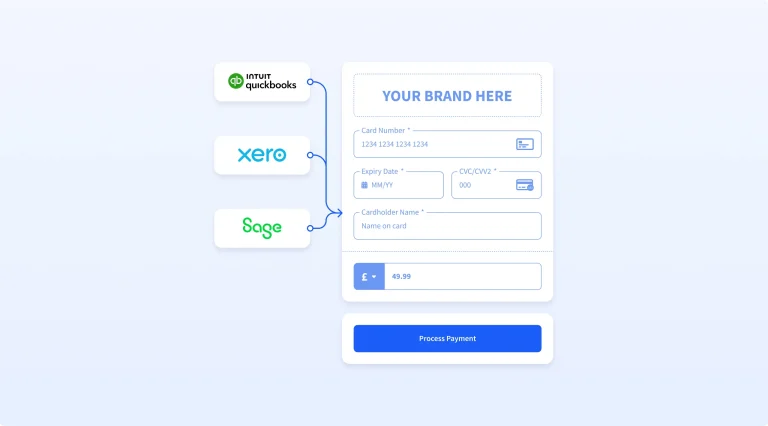
- Accounting software: Xero, QuickBooks, Sage
- Payment API and card-present API for software and EPOS integrations
- Industry-specific platforms, e.g. for property management, including Qube MRI, Rubixx, CPL, and STRATA by OtagoTech; MoveMan Pro for removal businesses; or eFD by Seker for funeral directors.
How a payment works through Blink Payment
When a customer pays through Blink Payment, here’s what happens:
- The customer enters their payment details (or authenticates via their banking app for open banking)
- Blink Payment’s platform captures, encrypts, and passes the payment data securely
- The transaction is sent to the relevant card network (Visa or Mastercard) or bank rails (Faster Payments for open banking)
- The issuing bank approves or declines
- The acquirer settles the funds into your merchant account
- The transaction appears in your Blink Payment dashboard, matched and reconciled
Is it safe to use a payment provider that isn’t FCA authorised?
Not every company involved in the payments chain needs to be FCA authorised. The FCA regulates the financial services layer: the institutions that hold funds, settle transactions, and provide regulated payment services. Providing technology services alone does not necessarily constitute a regulated payment service. Whether FCA authorisation is required depends on the activities a business performs and the role it plays in the payment chain.
This is a normal and well-established model across the UK payments industry. Many of the payment platforms businesses use every day operate exactly this way: the technology provider builds the product, and FCA-regulated acquirers handle the financial layer underneath.
The protections for your business don’t come from the technology provider being FCA authorised. They come from:
- FCA-regulated acquiring partners. The companies that settle your funds– Elavon, AIB Merchant Services, OBN and Cashflows in Blink Payment’s case – are all FCA-regulated. Your merchant account sits with them. The movement of money is governed by regulated institutions, not by the technology layer.
- PCI DSS Level 1 compliance. PCI DSS (Payment Card Industry Data Security Standard) is the security standard that governs how card data is handled. Level 1 is the highest tier, applying to organisations that process the largest volumes of card transactions. This is an independent, audited standard that applies regardless of FCA status.
- Strong Customer Authentication and 3D Secure. Under the UK’s Payment Services Regulations, Strong Customer Authentication (SCA) applies to many online card payments, subject to applicable exemptions. This protects both your business and your customers.
- Card tokenisation. Card details are never stored in their raw form. They are replaced with a token – a meaningless reference number – which cannot be used to reverse-engineer the original card data. This reduces the risk of a data breach, regardless of who the technology provider is.
In short, the protection isn’t in the FCA status of the technology layer. It’s in the regulated institutions that handle the money and the security standards that govern how the data is handled. Both are firmly in place.
Security and compliance
PCI DSS
Blink Payment’s platform is PCI Level 1 compliant, which is the highest tier of the Payment Card Industry Data Security Standard. This means cardholder data is handled and stored in accordance with the most stringent security requirements in the industry. Using a PCI-compliant payment platform can reduce the scope and complexity of a merchant’s PCI DSS responsibilities, depending on how payments are accepted and card data is handled.
FCA regulation
Blink Payment’s acquiring services are provided by FCA-regulated partners. The acquiring layer, where regulated financial services apply, sits with Elavon, AIB Merchant Services, OBN, and Cashflows, all of which are authorised and regulated by the Financial Conduct Authority.
Fraud prevention and authentication
Blink Payment’s platform includes:
- 3D Secure authentication (3DS2) for online card payments
- Strong Customer Authentication (SCA) compliance
- Real-time issuer checks
- Secure card tokenisation
- Encrypted payments
- Chargeback protection tools
Why the distinction matters for your business
If you’re choosing a payment provider, here’s why it’s worth understanding whether you’re buying a gateway, a processor, a PSP, or a payment technology provider:
- A gateway primarily provides the technology for transmitting payment information. Depending on the provider, you may still need separate acquiring, processing or merchant-account arrangements and additional tools for managing and reconciling payments.
- A single-acquirer PSP ties your rates and roadmap to one bank. If that acquirer changes its fees, reduces its service, or exits a market, your options are limited.
- A payment technology provider with multi-acquirer access gives you the platform, the tools, and the choice of acquirer.
For most UK SMEs, the practical outcome is simpler: one platform, every payment method, one dashboard, one support team. You don’t need to think about the layers underneath.
Frequently asked questions
Is it safe to use a payment provider that isn’t FCA authorised?
Yes, in many cases. The FCA regulates the financial services layer – the institutions that hold funds and settle transactions. The technology layer does not need to be FCA authorised to be safe or legitimate. What matters is that the acquiring partners handling your funds are FCA-regulated, and that the technology platform meets the security standards that protect cardholder data. Blink Payment’s platform is PCI Level 1 compliant, the highest tier of that standard.
Is Blink Payment a bank?
No. Blink Payment is a payment technology provider. It is not a bank and does not hold customer funds. Acquiring services are provided by FCA-regulated partners Elavon, AIB Merchant Services, OBN, and Cashflows.
Is Blink Payment a payment processor?
Blink Payment provides the technology platform for accepting and managing payments, while acquiring services are provided through FCA-regulated acquiring partners. The platform connects merchants with the relevant payment infrastructure and provides the tools used to process and manage transactions.
Who processes my payments?
Your payments are processed and settled by one of Blink Payment’s FCA-regulated acquiring partners: Elavon, AIB Merchant Services, OBN, or Cashflows. Blink Payment provides the platform that connects your business to those acquirers.
Is Blink Payment regulated?
Blink Payment is a technology provider registered in England & Wales. The acquiring services used by Blink Payment are provided by FCA-regulated partners. Payment data is handled in full compliance with PCI DSS Level 1 standards.
How long does it take to get started with Blink Payment?
Most businesses are up and running within about a week. There’s nothing to install; the platform is cloud-based, and the team provides dedicated onboarding support throughout the process.
Trusted by 3,000+ businesses across the UK. See our pricing, explore the platform, or get in touch to learn how Blink Payment can help your business.